How to Do a Goblet Squat With Good Form
Goblet squats are a great exercise for beginners who want to build strength in their legs and hips. They can also help you practice good squat technique before moving on to more challenging exercises.
The best part? You only need one dumbbell or kettlebell and enough space to stand comfortably.
However, lifting a weight with poor form can make the exercise harder than it needs to be. Learning the basic steps first can help you move with more control and confidence.
In this guide, you will learn how to do a goblet squat, avoid common mistakes, make the movement easier, and build it into your workout routine.
What Is a Goblet Squat?
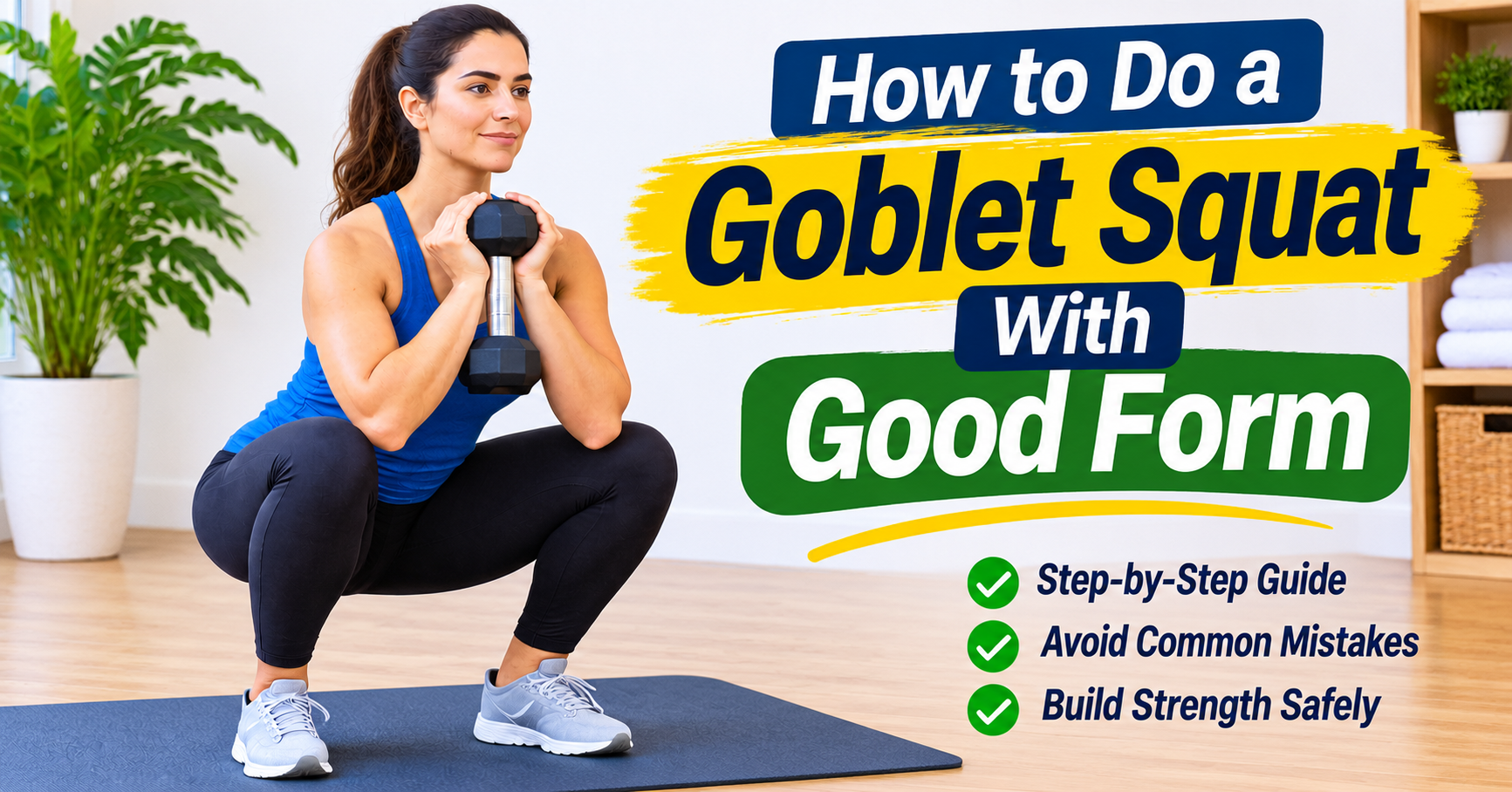
A goblet squat is a squat performed while holding one weight in front of your chest. The weight is usually a dumbbell or kettlebell.
You hold the weight with both hands, keep it close to your body, and bend your hips and knees to lower yourself into a squat.
This exercise works several muscles, including:
- Quadriceps: The muscles at the front of your thighs.
- Glutes: The muscles around your buttocks.
- Hamstrings: The muscles at the back of your thighs, which help support hip movement.
- Core muscles: These help keep your body steady.
- Upper back muscles: These help you maintain a comfortable, upright position.
Goblet squats are useful for beginners because holding the weight in front of your chest can make it easier to learn the movement. You can also start with a light weight and increase it gradually as your strength improves.
Benefits of Goblet Squats
Goblet squats offer several benefits when performed with suitable weight and good technique.
1. They Build Leg Strength
Squatting trains your thigh and hip muscles. These muscles help you perform everyday activities such as standing up from a chair, climbing stairs, and picking up objects from a low position.
Regular strength training can help you become stronger over time.
2. They Help You Practice Squat Form
Holding a weight in front of your chest gives you a simple way to practice a controlled squat.
The weight should remain close to your body. This can help you focus on keeping your feet steady, bending your hips and knees, and maintaining balance.
3. They Train Your Core
Your core muscles work to keep your trunk steady while you lower and raise your body.
You do not need to twist or bend your body to train these muscles. Focus on staying controlled throughout each repetition.
4. They Are Easy to Adjust
You can make goblet squats easier by using a lighter weight, reducing how far you squat, or practicing without a weight.
As your technique and strength improve, you may be able to increase the weight or perform more repetitions.
How to Do a Goblet Squat Step by Step
Follow these steps to learn the basic movement.
Step 1: Choose a Suitable Weight
Start with a light dumbbell or kettlebell that you can hold securely with both hands.
If you are new to squats, practice without a weight first. You can also use a sturdy chair behind you as a target for your hips.
The right starting weight should allow you to move smoothly without holding your breath or losing control.
Step 2: Stand With Your Feet in a Comfortable Position
Stand with your feet about shoulder-width apart, or slightly wider if that feels more natural.
Keep your toes pointing forward or turned slightly outward. The best position depends on your body and how your hips move.
Spread your weight across your feet so that your heels and the balls of your feet remain in contact with the floor.
Step 3: Hold the Weight at Your Chest
Hold one end of a dumbbell with both hands, or hold a kettlebell by its handles.
Keep the weight close to your chest. Let your elbows point down naturally rather than forcing them outward.
Stand tall, relax your shoulders, and look ahead.
Step 4: Tighten Your Core
Before lowering yourself, gently tighten your stomach muscles as if preparing for a small bump.
Keep breathing normally. You do not need to hold your breath throughout the movement.
Maintain a comfortable back position instead of rounding or excessively arching your lower back.
Step 5: Lower Into the Squat
Bend your hips and knees together, lowering your body as if you were sitting back toward a chair.
Keep your heels on the floor and your knees moving in the same general direction as your toes.
Hold the weight close to your chest. Lower only as far as you can while maintaining balance and comfortable control.
Your knees can move forward past your toes during a squat. This is not automatically a problem. What matters is using a comfortable range of motion and keeping your movement controlled.
Step 6: Stand Back Up
Press through your feet to return to a standing position.
Straighten your hips and knees smoothly without snapping them into place.
Keep the weight close to your chest and avoid leaning backward at the top.
That completes one repetition.
Step 7: Repeat With Good Control
Start with a small number of repetitions and focus on technique.
For example, you might begin with two sets of 6–8 repetitions if that feels comfortable and appropriate for your fitness level.
Rest between sets as needed. Stop if your form begins to break down or you experience pain.
Common Goblet Squat Mistakes and How to Fix Them
Even a simple exercise can become less effective when your technique needs attention.
| Common mistake | Why it can be a problem | How to improve it |
|---|---|---|
| Using a weight that is too heavy | Makes it harder to control the movement | Start lighter and increase gradually |
| Lifting your heels | Can reduce stability | Use a comfortable stance and keep your feet planted |
| Letting your knees collapse inward | Can make the movement less controlled | Guide your knees in the same direction as your toes |
| Rounding your back excessively | Makes it harder to maintain a stable position | Reduce the depth and keep the weight close |
| Dropping too quickly | Makes it harder to control the squat | Lower yourself at a steady pace |
| Holding your breath | Can make the exercise feel more difficult | Breathe steadily throughout each repetition |
| Squatting deeper than you can control | Can cause you to lose balance or position | Use a comfortable range of motion |
Mistake 1: Choosing Too Much Weight
A heavier dumbbell does not automatically produce better results.
If the weight makes you wobble, rush, or struggle to stand, reduce it. You can build strength with a lighter weight while learning the movement.
Mistake 2: Letting Your Knees Fall Inward
Your knees should generally follow the direction of your toes as you squat.
If they repeatedly collapse inward, try using a lighter weight and a smaller range of motion. Focus on controlled movement rather than forcing your knees far outward.
Mistake 3: Trying to Squat Too Deep
Not everyone has the same comfortable squat depth.
Your depth may depend on your mobility, body proportions, balance, and experience. Start with a range that allows you to keep your feet planted and maintain control.
You can work on greater depth gradually if it feels comfortable.
How to Make Goblet Squats Easier
If you are a beginner, you do not need to start with a heavy weight or a deep squat.
Try these options.
Practice Bodyweight Squats
Stand with your feet in a comfortable position and perform the squat without holding anything.
This allows you to learn the movement before adding resistance.
Use a Chair for Support
Place a sturdy chair behind you. Lower yourself toward the seat and lightly touch it before standing again.
Do not drop onto the chair or use a chair that can slide easily.
Reduce the Squat Depth
Bend your hips and knees only as far as you can comfortably control.
As you become more confident, you may gradually increase the depth.
Use a Lighter Dumbbell
Choose a weight that allows you to keep the dumbbell steady and complete each repetition without rushing.
Good technique should come before heavier lifting.
How Many Goblet Squats Should Beginners Do?
There is no single number that is right for everyone.
Your starting point depends on your current fitness level, experience, available weight, and how comfortably you can perform the movement.
Here is one simple starting guide:
| Experience level | Example starting point | Main goal |
|---|---|---|
| New to squats | 1–2 sets of 5–8 bodyweight repetitions | Learn the movement |
| Comfortable with bodyweight squats | 2 sets of 6–8 light goblet squats | Practice controlled technique |
| More experienced beginner | 2–3 sets of 8–10 repetitions with a suitable weight | Build strength gradually |
These are examples, not strict rules. You may need fewer repetitions or more rest.
Start with a weight that lets you finish each set with good control. Leave yourself enough energy to maintain proper form instead of pushing every set to exhaustion.
How Often Should You Do Goblet Squats?
Many beginners can include goblet squats in a full-body strength workout two days per week.
Allow time for recovery between sessions, especially when you are new to resistance training.
You do not need to perform goblet squats every day to make progress. Consistency, appropriate effort, and gradual improvement are more useful than doing too much too soon.
You can also combine them with other movements, such as:
- Wall push-ups or incline push-ups
- Dumbbell rows
- Glute bridges
- Standing calf raises
- Gentle walking
Choose exercises that suit your abilities and goals. Increase the challenge gradually as your body adapts.
Goblet Squats vs. Bodyweight Squats
Both exercises can help beginners practice the squat movement. The main difference is the added weight.
| Feature | Bodyweight squat | Goblet squat |
|---|---|---|
| Equipment | None | One dumbbell or kettlebell |
| Difficulty | Often easier to start | Usually more challenging because of added weight |
| Main purpose | Learn movement and build basic strength | Practice squats while adding resistance |
| Beginner-friendly | Yes | Yes, with a suitable weight |
| Progression | Improve control, repetitions, or range | Gradually increase weight, repetitions, or control |
If you are new to exercise, bodyweight squats are a good starting point. You can move to goblet squats when you feel comfortable and can perform the basic movement with control.
Safety Tips Before You Start
Goblet squats are suitable for many people, but the exercise may need changes based on your health and abilities.
Keep these points in mind:
- Warm up with a few minutes of easy movement before your workout.
- Use a weight that you can hold securely.
- Make sure the floor is stable and free from obstacles.
- Keep your movement smooth instead of bouncing at the bottom.
- Stop if you feel sharp pain, dizziness, or unusual discomfort.
- Do not force a range of motion that feels painful.
If you have a current injury, ongoing knee or hip pain, balance problems, or a medical condition that affects exercise, ask a qualified healthcare professional about suitable modifications before starting.
Seek help from a qualified fitness professional if you need assistance learning the movement.
Frequently Asked Questions
1. Are goblet squats good for beginners?
Yes. Goblet squats can be a useful beginner exercise because you hold the weight in front of your chest and can start with a light load. Practice bodyweight squats first if you are not yet comfortable with the movement.
2. Which muscles do goblet squats work?
They mainly work the quadriceps and glutes. Your hamstrings, core, and upper back muscles also help support the movement.
3. Should my knees go past my toes during a goblet squat?
They can. Your knees moving past your toes is not automatically a sign of poor form. Focus on a comfortable stance, stable feet, controlled movement, and a range of motion that suits your abilities.
4. How heavy should my goblet squat weight be?
Choose a weight that allows you to complete your repetitions with steady control. If you struggle to hold the weight or your form changes significantly, use a lighter one.
5. How low should I squat?
Lower yourself as far as you comfortably can while keeping your feet planted and your movement controlled. You do not need to reach a specific depth if doing so causes discomfort or makes you lose balance.
6. Can I do goblet squats without a dumbbell?
Yes. You can practice the same movement using only your body weight. This is a useful way to learn the technique before adding resistance.
7. Are goblet squats better than regular squats?
Neither version is best for everyone. Bodyweight squats are useful for learning the movement, while goblet squats add resistance. Choose the version that matches your current abilities and goals.
8. How many sets should I do?
Two sets of 6–8 repetitions can be a reasonable starting example for someone who is comfortable with the movement. Adjust the number to your fitness level, and prioritize good technique over completing more repetitions.
9. Can goblet squats help build muscle?
Yes. Goblet squats can support muscle growth when performed as part of a suitable strength-training program. Progress depends on factors such as training consistency, resistance, recovery, and nutrition.
10. Should goblet squats hurt my knees?
The exercise should not cause sharp or worsening knee pain. If you experience pain, stop and review your technique and range of motion. Seek advice from a qualified healthcare professional if the pain continues or concerns you.
Key Takeaways
- Goblet squats train the thighs, glutes, and supporting muscles.
- Start with bodyweight squats or a light dumbbell if you are new to the exercise.
- Hold the weight close to your chest and keep your feet stable.
- Let your knees follow the direction of your toes.
- Use a comfortable squat depth rather than forcing a deep position.
- Increase the weight gradually as your technique improves.
- Stop if you experience pain or unusual symptoms.
Conclusion
Goblet squats are a practical way to build lower-body strength and learn good squat technique. You do not need heavy weights or complicated equipment to get started.
Begin with a comfortable stance, hold a light weight close to your chest, and lower yourself with control. Focus on performing each repetition well instead of rushing to complete more.
With regular practice and enough recovery, you can gradually build confidence and strength. Start at your current level, make changes when needed, and choose a version of the exercise that feels right for your body.
Medical disclaimer: This article is for educational purposes only and does not replace professional medical advice, diagnosis, or treatment.