Resistance Band Workout for Beginners at Home
You do not need an expensive gym membership or heavy weights to start building strength. A simple resistance band can help you exercise at home, improve your strength, and build a regular fitness routine.
Resistance bands are lightweight, easy to store, and useful for many types of workouts. You can use them to train your legs, arms, shoulders, back, and core. They also come in different resistance levels, so you can choose one that matches your current fitness level.
If you are new to exercise, resistance band workouts can be a practical way to get started. You can perform many exercises in a small space and adjust the difficulty as you become stronger.
In this guide, you will learn how to use resistance bands, which exercises beginners can try, and how to follow a simple workout plan at home.
Table of Contents
- What Is a Resistance Band Workout?
- Benefits of Resistance Band Training
- Types of Resistance Bands
- What Beginners Need Before Starting
- 10 Resistance Band Exercises for Beginners
- A Simple Full-Body Workout Plan
- How Often Should Beginners Train?
- Common Mistakes to Avoid
- Safety Tips for Resistance Band Workouts
- Frequently Asked Questions
- Key Takeaways
- Final Thoughts
1. What Is a Resistance Band Workout?
A resistance band workout uses an elastic band to create resistance while you move your body.
For example, when you pull a band apart or stretch it during a squat, your muscles work against that resistance. This can help you develop strength over time.
Unlike traditional dumbbells, resistance bands are flexible and lightweight. You can use them for exercises that target different muscle groups without needing much equipment.
Resistance bands are available in several shapes and sizes. Some are small loops, while others are long bands with handles.
Beginners can use resistance bands for exercises such as:
- Squats
- Bicep curls
- Shoulder presses
- Rows
- Glute bridges
- Chest presses
- Side steps
You can perform these exercises at home, outdoors, or in a gym.
Important: Resistance bands are not automatically easy or risk-free. Choose a suitable resistance level, learn the correct movement, and increase difficulty gradually.
2. Benefits of Resistance Band Training
Resistance band training can be a useful part of a balanced fitness routine. Here are some reasons beginners may enjoy it.
Easy to Use at Home
You do not need a large workout area to perform many resistance band exercises.
A clear space with enough room to move your arms and legs is usually sufficient. This makes resistance bands useful for people who prefer exercising at home.
Suitable for Different Fitness Levels
Resistance bands come in different resistance levels.
A beginner can start with a lighter band and move to a stronger one when the exercises become easier. You can also change your body position or range of movement to adjust the challenge.
Remember that band colors do not mean the same thing for every brand. Check the manufacturer’s resistance guide instead of choosing a band based only on its color.
Can Help Build Strength
Resistance band exercises challenge your muscles as you push, pull, or control a movement.
When combined with regular training and enough recovery, this type of exercise can help improve muscular strength.
To keep making progress, you may eventually need to increase the resistance, perform more repetitions, or choose a more challenging exercise.
Lightweight and Portable
Resistance bands are easy to carry in a bag or store in a drawer.
You can use them while traveling or when you cannot get to a gym. Always check the band for damage before using it.
Can Support a Full-Body Workout
You can use resistance bands to train your upper body, lower body, and core.
A well-planned routine can include pushing movements, pulling movements, and exercises for your legs and hips.
However, resistance bands are only one option for strength training. Bodyweight exercises and weights can also be useful, depending on your goals and preferences.
3. Types of Resistance Bands
Different resistance bands work better for different exercises. You do not need to buy every type when you are starting.
| Band type | What it looks like | Common uses |
|---|---|---|
| Loop band | A small closed loop | Squats, glute bridges, and side steps |
| Long flat band | A long, flat strip of elastic material | Stretching, mobility work, and some strength exercises |
| Tube band with handles | An elastic tube with handles | Rows, curls, and presses |
| Long loop band | A large closed loop | Certain rows, assisted movements, and lower-body exercises |
A light or medium band may be a useful starting point, but the best choice depends on your strength and the exercise.
Choose a band that lets you complete each repetition with control. If you cannot maintain good form, the resistance may be too high.
4. What Beginners Need Before Starting
You do not need much equipment for a basic resistance band workout.
Prepare the following items before exercising.
A Suitable Resistance Band
Choose a band that matches your current ability.
You may eventually want different resistance levels for different muscle groups. For now, one suitable band may be enough to learn the basic movements.
A Clear Workout Space
Move furniture and other objects out of the way.
Make sure the floor is stable and not slippery. You should have enough room to step, bend your knees, and move your arms without hitting anything.
Comfortable Clothing
Wear clothing that allows you to move freely.
Choose comfortable shoes when they help you maintain stability, particularly for standing exercises.
A Water Bottle
Keep water nearby and drink according to your needs.
You may not need much water during a short, easy workout, but staying hydrated throughout the day is important.
A Short Warm-Up
Start with five to ten minutes of gentle movement.
You could march in place, walk around your room, move your arms, and perform a few comfortable bodyweight squats.
The goal is to prepare for exercise rather than tire yourself out before the workout begins.
5. 10 Resistance Band Exercises for Beginners
The following exercises target different parts of your body. Start with a light band and focus on smooth, controlled movements.
For your first workout, choose six or seven exercises rather than trying to complete everything at once.
Exercise 1: Resistance Band Squat
Main muscles: Thighs and glutes.
Squats are a useful lower-body exercise that can help build strength in your legs and hips.
How to do it:
- Stand with your feet about shoulder-width apart.
- If using a long band, hold it securely in your hands or follow the manufacturer’s instructions for positioning it safely.
- Bend your knees and push your hips backward as if sitting in a chair.
- Keep your feet flat and your chest in a comfortable position.
- Push through your feet to return to standing.
Start with 8–10 repetitions.
If the band makes it difficult to keep your balance or control the movement, perform bodyweight squats first.
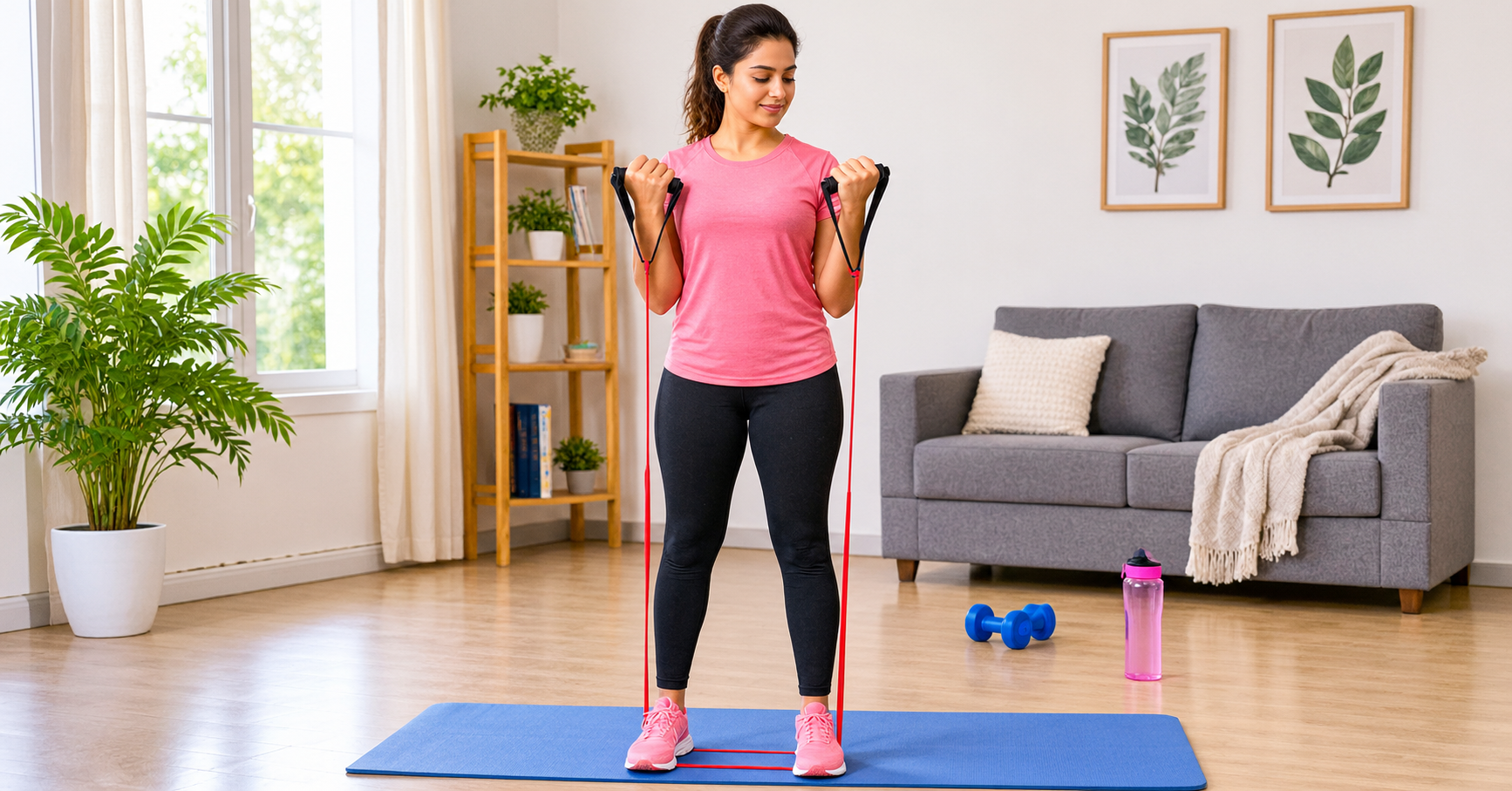
Exercise 2: Resistance Band Bicep Curl
Main muscles: Biceps at the front of your upper arms.
Bicep curls help train the muscles used when bending your elbows.
How to do it:
- Stand securely on the middle of a suitable long band, if designed for this use.
- Hold one end in each hand.
- Keep your elbows close to your sides.
- Bend your elbows and bring your hands toward your shoulders.
- Lower your hands slowly.
Try 8–12 repetitions.
Avoid swinging your body or using momentum to lift the band. Reduce the resistance if you cannot control the lowering movement.
Exercise 3: Resistance Band Row
Main muscles: Upper back and muscles that bend your elbows.
Rows train pulling movements and can help strengthen your back.
How to do it:
- Sit or stand in a stable position.
- Use a secure anchor only if the band is designed for that setup and the anchor is suitable.
- Hold the band with your arms extended in front of you.
- Pull your elbows backward while keeping your shoulders relaxed.
- Slowly return to the starting position.
Perform 8–12 repetitions.
Do not attach a band to a weak door handle or an unsecured object. If you do not have a safe anchor, choose a standing band exercise that does not require one.
Exercise 4: Resistance Band Shoulder Press
Main muscles: Shoulders and triceps.
This exercise trains the muscles used to press your arms overhead.
How to do it:
- Stand on the middle of a suitable long band.
- Hold the ends near shoulder height.
- Keep your feet stable and your stomach gently engaged.
- Press your hands upward without forcing your shoulders.
- Lower your hands slowly to shoulder height.
Try 8–10 repetitions.
Use light resistance and a comfortable range of motion. If overhead movement causes pain, stop and choose a different exercise.
Exercise 5: Glute Bridge With a Loop Band
Main muscles: Glutes and hips.
A glute bridge trains the muscles around your hips while you lie on the floor.
How to do it:
- Lie on your back with your knees bent and feet flat on the floor.
- If using a loop band, place it around your thighs above your knees, following the product instructions.
- Keep your feet about hip-width apart.
- Gently press your feet into the floor and lift your hips.
- Pause briefly, then lower your hips with control.
Complete 10–12 repetitions.
Avoid arching your lower back excessively. If the band causes your knees to move inward or makes the exercise uncomfortable, remove it and perform a regular glute bridge.
Exercise 6: Standing Band Chest Press
Main muscles: Chest, shoulders, and triceps.
This exercise trains a pushing movement.
How to do it:
- Position the band behind your upper back only if it is designed for this exercise.
- Hold an end in each hand.
- Start with your hands near your chest.
- Push your hands forward without locking your elbows forcefully.
- Return slowly to the starting position.
Try 8–12 repetitions.
Check that the band is not twisted or damaged and that it cannot slip toward your face. Stop if you cannot keep it secure.
Exercise 7: Lateral Band Walk
Main muscles: Glutes and muscles around the hips.
Lateral band walks involve taking small steps to the side against the band’s resistance.
How to do it:
- Place a suitable loop band around your thighs, above your knees.
- Stand with your feet about hip-width apart.
- Bend your knees slightly.
- Take a small step to one side.
- Bring the other foot toward it without letting the band go slack.
- Repeat in the opposite direction.
Try 6–10 steps in each direction.
Keep your steps small and controlled. You do not need a very strong band to make this exercise useful.
Exercise 8: Standing Band Pull-Apart
Main muscles: Upper back and rear shoulder muscles.
This exercise involves pulling a band apart in front of your body.
How to do it:
- Hold a light resistance band in front of your chest.
- Keep your arms comfortably extended.
- Pull your hands apart by moving your arms outward.
- Keep your shoulders relaxed.
- Return slowly to the starting position.
Perform 8–12 repetitions.
Use a light band and avoid shrugging your shoulders toward your ears.
Exercise 9: Standing Band Hip Extension
Main muscles: Glutes.
This exercise trains the muscles that move your leg backward.
How to do it:
- Stand beside a stable support if you need help with balance.
- Use a band and setup designed for standing hip exercises.
- Keep your torso upright.
- Move one leg backward a short distance without arching your back.
- Return to the starting position.
- Repeat on the other side.
Try 8–10 repetitions per leg.
Do not use an improvised attachment that could snap or pull loose. You can perform the same movement without a band if you are unsure about the setup.
Exercise 10: Resistance Band Deadlift
Main muscles: Glutes, hamstrings, and other muscles around the hips and back.
A band deadlift teaches a hip-hinge movement, which involves bending at the hips while maintaining a controlled back position.
How to do it:
- Stand on a suitable long band with your feet about hip-width apart.
- Hold the ends securely.
- Keep your knees slightly bent.
- Push your hips backward and lean forward comfortably.
- Press through your feet and move your hips forward to stand tall.
- Return to the starting position slowly.
Start with 8–10 repetitions.
Keep the band positioned securely under your feet. Do not use a damaged band or pull harder than you can control.
6. A Simple Full-Body Workout Plan
Here is a beginner-friendly workout you can follow at home.
You do not need to perform all ten exercises in one session. Start with a smaller selection and learn the movements first.
Beginner Workout
| Exercise | Sets | Repetitions |
|---|---|---|
| Resistance band squat | 1–2 | 8–10 |
| Resistance band row | 1–2 | 8–12 |
| Resistance band bicep curl | 1–2 | 8–12 |
| Glute bridge | 1–2 | 10–12 |
| Standing band shoulder press | 1–2 | 8–10 |
| Lateral band walk | 1–2 | 6–10 steps each way |
Rest for about 30–90 seconds between sets, or longer if needed.
These numbers are starting suggestions, not strict rules. You can perform fewer repetitions if you are new to exercise.
If a movement becomes difficult enough that your technique changes, stop the set. You do not need to train until your muscles feel completely exhausted.
How to Progress
For the first week, focus on learning the exercises and completing them comfortably.
Once the workout feels manageable, you can gradually make it more challenging by:
- Adding a few repetitions.
- Adding another set.
- Using a slightly stronger band.
- Slowing down the movement.
- Improving your control and range of motion.
Change one thing at a time. You do not need to increase resistance and workout volume at the same time.
If a stronger band makes you lose control, return to the lighter one.
7. How Often Should Beginners Train?
Many beginners can start with two full-body resistance band workouts per week on nonconsecutive days.
For example:
| Day | Activity |
|---|---|
| Monday | Full-body resistance band workout |
| Tuesday | Walking or gentle activity |
| Wednesday | Rest or light movement |
| Thursday | Full-body resistance band workout |
| Friday | Walking or gentle activity |
| Saturday | Optional easy activity |
| Sunday | Rest |
This is only an example. Your schedule should fit your fitness level and recovery needs.
Avoid training the same muscles hard every day when you are first learning. Rest allows your body to recover between sessions.
You can combine resistance band workouts with walking, cycling, or other activities you enjoy.
If you are new to all forms of exercise, start with shorter sessions and increase the workload gradually.
8. Common Mistakes to Avoid
Resistance bands may look simple, but using them incorrectly can make exercises less effective or increase your risk of injury.
Choosing a Band That Is Too Strong
A very strong band may make it difficult to complete the movement properly.
Start with a resistance level that allows you to move smoothly. Increase the challenge only when you can maintain good technique.
Moving Too Quickly
Fast, uncontrolled repetitions can reduce your ability to control the band.
Move steadily in both directions. Pay attention to the lowering phase instead of allowing the band to pull you back suddenly.
Using Poor Posture
Try to keep your body stable during each exercise.
Avoid excessive back arching, twisting, or swinging to complete a repetition. If you cannot maintain your position, reduce the resistance or choose an easier variation.
Skipping Warm-Ups
Going straight into a challenging set may leave you feeling stiff or unprepared.
Begin with a few minutes of gentle movement and perform the first set with light resistance.
Ignoring Band Damage
Small tears, cracks, or worn areas can cause a band to break unexpectedly.
Inspect the band before each workout. Replace it if you notice damage.
Expecting Instant Results
Strength improves through consistent practice, not one difficult workout.
Focus on regular training, good technique, sleep, and recovery. Progress will vary from person to person.
9. Safety Tips for Resistance Band Workouts
Keep these safety points in mind whenever you exercise.
- Check your band for cracks, tears, or other damage.
- Follow the manufacturer’s instructions for how to hold or attach it.
- Avoid attaching a band to an unstable object.
- Keep the band away from your face when stretching it.
- Use enough space to move safely.
- Do not pull the band beyond its recommended stretch.
- Stop if you experience sharp pain, numbness, or unusual discomfort.
- Increase resistance gradually rather than rushing to a harder band.
- Store bands away from excessive heat and direct sunlight when the manufacturer recommends it.
If you have a recent injury, balance problems, or a medical condition that affects exercise, ask a qualified healthcare professional for guidance before starting.
10. Frequently Asked Questions
1. Are resistance bands good for beginners?
Yes. Resistance bands can be useful for beginners because they are lightweight and available in different resistance levels. Start with simple exercises and a band that allows you to move with control.
2. Can I build muscle with resistance bands at home?
Resistance bands can help build muscle when you use them consistently and gradually increase the challenge. Your results depend on your training, nutrition, recovery, experience, and other individual factors.
3. How long should a beginner resistance band workout last?
A beginner session may take around 15–30 minutes, including a warm-up and rest periods. You can start with a shorter workout and increase the duration as you become more comfortable.
4. How many times a week should I use resistance bands?
Two full-body sessions per week on separate days can be a practical starting point for many beginners. You may adjust the schedule according to your recovery and fitness level.
5. What resistance band should a beginner buy?
Choose a band that allows you to perform your selected exercises with good control. A lighter band may be suitable for smaller muscle groups or learning new movements. Resistance needs vary, so check the manufacturer’s guidance.
6. Can resistance bands help with weight loss?
Resistance band workouts use energy and can help you maintain or build muscle as part of an overall fitness routine. Weight change depends on several factors, including eating habits, daily activity, sleep, and individual health. No single exercise guarantees weight loss.
7. Are resistance bands better than dumbbells?
Neither option is automatically better for everyone. Resistance bands are lightweight and portable, while dumbbells provide another way to add resistance. Both can be useful for strength training.
8. Can I use resistance bands every day?
You can use bands for different types of movement, but challenging the same muscles hard every day may not give them enough time to recover. Beginners often benefit from spacing full-body strength sessions across the week.
9. Do I need different resistance bands for different exercises?
Not necessarily. You can start with one suitable band, but you may find that different exercises require different resistance levels. A band that works for squats may feel too strong for shoulder exercises or too light for rows.
10. Can resistance bands replace a gym membership?
Resistance bands can support a useful home strength routine, particularly for beginners. However, whether they meet all your goals depends on the exercises you need, the resistance available, and how you plan to progress.
11. Key Takeaways
- Resistance bands are a practical option for home strength training.
- Beginners can use them to exercise their arms, shoulders, back, legs, hips, and core.
- Start with a suitable resistance level and focus on proper technique.
- Two full-body workouts per week can be a reasonable starting point for many people.
- Use controlled movements instead of rushing through repetitions.
- Check your bands for damage before each workout.
- Increase the challenge gradually as your strength improves.
- Combine strength training with other healthy habits for a balanced routine.
12. Final Thoughts
Starting a fitness routine at home does not have to be complicated. A resistance band and a little space can help you begin working on your strength without buying a lot of equipment.
Choose a few beginner-friendly exercises, learn how to perform them correctly, and follow a schedule you can maintain. Give yourself time to improve instead of trying to do too much during your first workout.
As the exercises become easier, you can gradually increase the repetitions, add sets, or choose a stronger band.
The most important part is consistency. A simple workout that fits your life is often easier to maintain than a complicated routine that leaves you feeling overwhelmed.
Start slowly, pay attention to your body, and build your strength one workout at a time.
Medical disclaimer: This article is for educational and informational purposes only. It does not replace professional medical advice, diagnosis, or treatment. Consult a qualified healthcare professional before starting a new exercise program if you have a medical condition, recent injury, or concerns about whether these exercises are appropriate for you.