
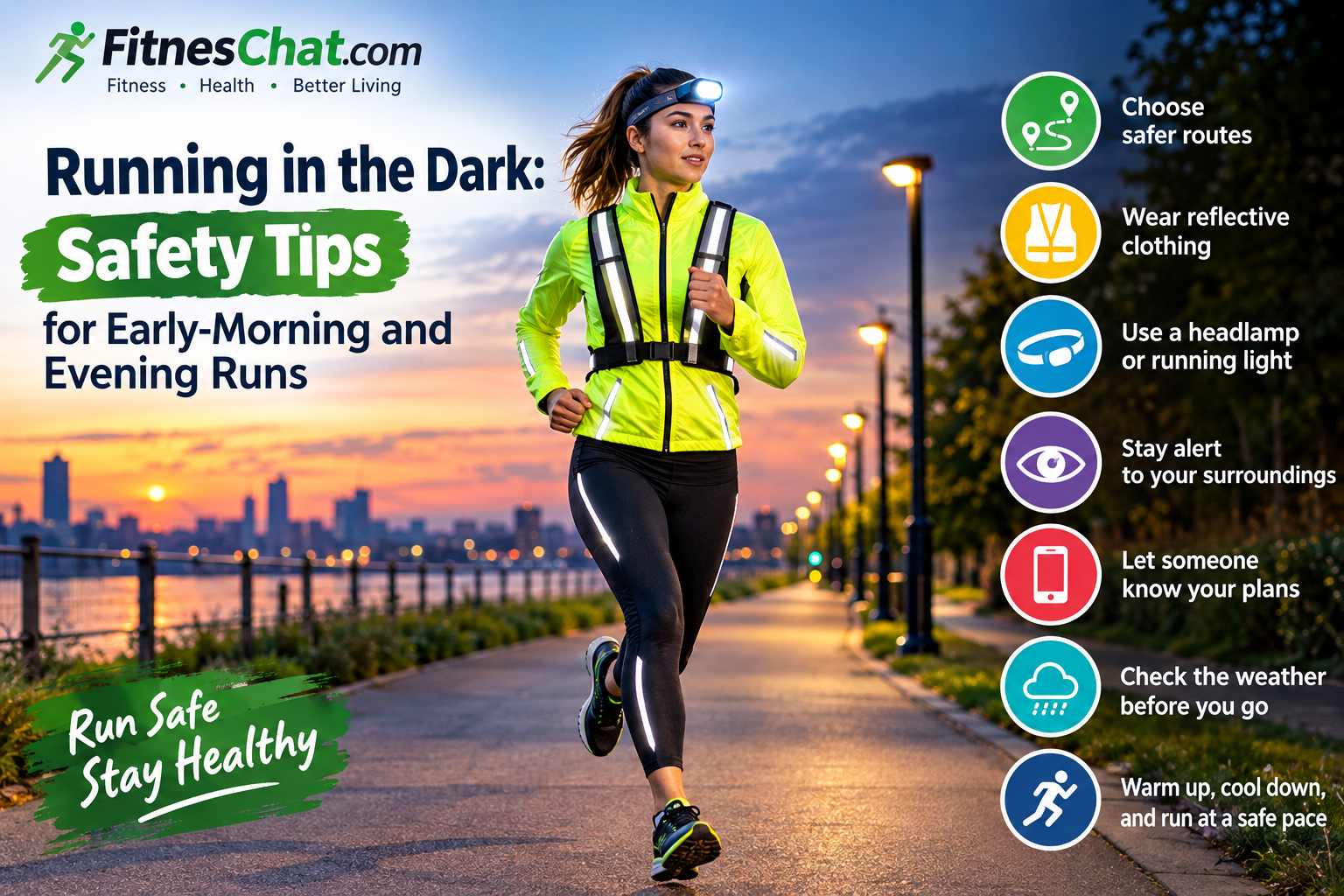
Running in the Dark: Safety Tips for Early-Morning and Evening Runs
Running is a great way to stay active, improve your fitness, and support your overall health. But finding time to run during daylight hours is not always easy. You may need to run before work, after school, or in the evening when the sun has already gone down.
Running in the dark can be a good way to keep up with your exercise routine. However, it requires extra care. Drivers may have trouble seeing you, roads may be harder to judge, and some paths may have poor lighting.
The good news is that a few simple steps can help you make your runs safer and more comfortable.
In this guide, you will learn how to choose safer routes, improve your visibility, stay aware of your surroundings, and prepare for early-morning or evening runs. Whether you are a beginner or an experienced runner, these tips can help you build a safer running routine.
Table of Contents
- Why Running in the Dark Requires Extra Care
- Choose Safer Running Routes
- Wear Clothing That Helps Others See You
- Use a Headlamp or Running Light
- Stay Alert During Your Run
- Adjust Your Running Pace
- Tell Someone About Your Running Plans
- Check the Weather Before You Leave
- Warm Up and Cool Down Properly
- Build a Safe Running Routine
- Common Mistakes to Avoid
- Frequently Asked Questions
- Key Takeaways
- Final Thoughts
1. Why Running in the Dark Requires Extra Care
Running before sunrise or after sunset can help you fit exercise into a busy day. It may also be easier to find time for a run when your schedule is less crowded.
However, darkness changes how you see and how other people see you.
For example, a driver may notice a person wearing bright reflective clothing much sooner than someone wearing dark clothes. A small hole in the sidewalk may also be harder to spot at night.
Here are some common challenges to consider:
- Reduced visibility: Drivers, cyclists, and other runners may not see you easily.
- Hidden obstacles: Rocks, uneven sidewalks, branches, and potholes can be harder to notice.
- Limited lighting: Some parks and running paths have few lights.
- Traffic risks: It can be harder to judge the speed and distance of approaching vehicles.
- Personal safety concerns: Quiet or isolated areas may have fewer people nearby if you need help.
These challenges do not mean you must stop running after sunset. Instead, they mean you should plan ahead and make safety part of every run.
2. Choose Safer Running Routes
Your running route is one of the most important parts of staying safe in low light.
A familiar route can help you feel more comfortable because you already know where the turns, crossings, and uneven areas are. Still, you should not assume that a familiar path is always safe.
Pick well-lit streets and paths
Whenever possible, choose streets with working streetlights, clear sidewalks, and good visibility.
Running paths near homes, shops, or other active public areas may also be a better choice than isolated roads.
Avoid routes with long, dark sections if you cannot see the ground clearly.
Choose routes with sidewalks
Sidewalks can help separate you from moving traffic. If your route has no sidewalk, consider choosing another road with less traffic and better visibility.
When you must run near traffic, stay alert and follow local road rules.
Where there is no sidewalk, pedestrian rules can differ by location. In many places, pedestrians are advised to face approaching traffic, but you should follow the rules that apply where you live.
Learn your route during daylight
If you plan to run a new route at night, try walking or running it during daylight first.
Look for:
- Uneven sidewalks
- Busy intersections
- Poorly lit areas
- Construction zones
- Places where cars enter or leave driveways
- Safe places to stop if you need help
Knowing what to expect can make your run easier to manage.
Avoid isolated areas
A quiet trail may feel peaceful during the day but become difficult to navigate after dark.
Consider running with a friend or choosing a busier, well-lit route instead.
Practical tip: Plan a short loop near your home before trying a long nighttime route. You can learn how the area feels in low light without traveling too far from familiar surroundings.
3. Wear Clothing That Helps Others See You
What you wear can make a real difference when running in the dark.
Dark clothing may be comfortable, but it can blend into the road or background at night. Clothing that improves visibility can help drivers and other people notice you sooner.
Choose bright clothing
Wear visible colors such as yellow, orange, or bright green when possible.
Bright colors can help during dawn and dusk, although their usefulness depends on the background and available light.
Add reflective gear
Reflective clothing and accessories can reflect light from vehicle headlights and other light sources.
Consider using:
- A reflective running vest
- Reflective bands for your arms or legs
- Reflective strips on your shoes
- A reflective jacket
- Reflective accessories for your backpack
For better visibility, use reflective items in more than one area of your body.
Do not rely on bright colors alone
Bright clothing is helpful, but it does not replace reflective materials or active lighting.
For example, a bright shirt may be difficult to see in a poorly lit area. Reflective gear can help when headlights shine toward you, while a running light can help you see the path ahead.
Using a combination of these items is a practical approach to low-light running.
4. Use a Headlamp or Running Light
A running light can help you see the ground and make yourself easier to notice.
This is especially helpful on routes with limited streetlights, uneven paths, or unexpected obstacles.
Wear a headlamp
A headlamp attaches to your head and shines light where you look.
It can help you spot cracks in the sidewalk, small rocks, and other hazards before reaching them.
Choose a headlamp that feels comfortable and provides enough light for your route. Adjust the angle so the beam helps you see the ground without unnecessarily shining into other people’s eyes.
Consider a chest light
Some runners prefer a light that attaches to their chest.
A chest light can provide a different angle of illumination and may feel more comfortable for people who do not like wearing a headlamp.
Try it on a short run before using it for a longer workout.
Use a small backup light
A small flashlight or backup light can be useful if your main light stops working.
Before leaving, check the battery and make sure the light works properly.
If you are running on a very dark route and your light fails, it is safer to stop the workout or move to a well-lit area than to continue running where you cannot see the ground.
5. Stay Alert During Your Run
Running safely in the dark requires attention to your surroundings.
Music and podcasts can make a run more enjoyable, but they may also distract you from traffic, bicycles, people, or other hazards.
Keep the volume low or skip headphones
Consider running without headphones in areas with traffic or poor lighting.
If you choose to use them, keep the volume low enough to hear nearby activity. Open-ear headphones may be an option, but they do not remove the need to look around and listen carefully.
Follow local rules regarding headphone use while running or crossing roads.
Put your phone away when moving
Your phone can help you navigate or contact someone in an emergency. However, looking at the screen while running can distract you from the path.
Check directions before you leave. If you need to change your route, stop somewhere safe before using your phone.
Keep it in a secure pocket or running belt so you can reach it when needed.
Watch for vehicles
Never assume a driver has seen you simply because you can see the vehicle.
Pay extra attention at intersections, driveways, parking lots, and road crossings.
Make eye contact with a driver when possible, but do not treat eye contact as a guarantee that the vehicle will stop.
Wait until you can safely cross.
Stay aware of people and animals
Look ahead and notice what is happening around you.
Be ready to slow down when approaching other runners, walkers, cyclists, or animals. Avoid sudden movements that could cause a collision.
Staying alert allows you to respond more quickly when something unexpected happens.
6. Adjust Your Running Pace
Your normal running pace may not be suitable for every nighttime route.
When visibility is limited, slowing down can give you more time to notice obstacles and respond to changes around you.
Start at an easy pace
Begin your run with a comfortable pace, especially if you are running in an unfamiliar area.
You should be able to speak in short sentences during an easy run.
If the ground is uneven or the lighting is poor, slow down further.
Walk when necessary
There is no problem with walking during a run.
You may need to walk when crossing a road, moving through a dark section, approaching an obstacle, or passing through a crowded area.
Walking can be a smart safety choice rather than a sign of poor fitness.
Avoid sudden changes in direction
Make turns carefully and watch for other people using the same path.
If you are following a training plan, do not feel that you must maintain a certain speed at the expense of safety.
Your training will still be useful if you slow down or shorten a workout when conditions are not suitable.
7. Tell Someone About Your Running Plans
Letting another person know about your run is a simple precaution.
You do not need to share every detail of your workout. A short message can help someone know where you plan to go and when you expect to return.
Share your route and expected return time
Before leaving, tell a trusted person:
- Where you plan to run
- Approximately how long you expect to be out
- When you expect to return
If your plans change significantly, send an update when it is safe to do so.
Carry your phone
A charged phone can help you access directions, contact someone, or call emergency services if needed.
Check the battery before you leave and make sure you can unlock and use the phone.
In some areas, mobile coverage may be limited, so do not depend entirely on your phone as your only safety measure.
Consider location sharing
If you feel comfortable doing so, use a location-sharing feature with a trusted friend or family member.
Some running apps also provide safety features, but availability varies.
Test any feature before relying on it. Make sure you understand how it works and who can see your location.
Run with a partner when possible
Running with another person can make a workout more enjoyable and provide extra support if something goes wrong.
If you prefer to run alone, choose a route that feels safe and keep your plans simple.
8. Check the Weather Before You Leave
Weather conditions can make nighttime running more challenging.
Rain, fog, strong winds, and extreme temperatures can affect visibility, comfort, and footing.
Be careful on wet surfaces
Rain can make sidewalks, painted road markings, metal covers, and fallen leaves slippery.
Take shorter steps and reduce your pace when the ground is wet.
Avoid running through standing water if you cannot see what is underneath.
Dress for the temperature
Early mornings can be colder than expected, even when the afternoon was warm.
Wear comfortable layers that match the conditions. Avoid clothing that makes it difficult to move freely or see clearly.
If you are running in cold weather, protect exposed skin when necessary and pay attention to signs of excessive cold.
Watch for fog and poor visibility
Fog can make it difficult for drivers and runners to see clearly.
Reflective gear and lights may help, but they cannot remove every risk.
If visibility is extremely poor, consider running indoors or waiting until conditions improve.
Stay hydrated
You may not feel as thirsty in cool weather as you do in hot weather, but your body still needs fluids.
Drink water regularly throughout the day. For many short, easy runs, drinking according to thirst is a reasonable approach.
Longer workouts, hot conditions, and heavy sweating may require more careful hydration planning.
9. Warm Up and Cool Down Properly
A good warm-up prepares your body for exercise. A cool-down helps you move gradually from exercise to rest.
These steps are useful whether you run in daylight or darkness.
Start with an easy warm-up
Spend about five to ten minutes walking briskly or jogging slowly before a more demanding workout.
You can also include gentle, dynamic movements, such as controlled leg swings or marching in place.
If you are running in a dark area, complete your warm-up somewhere well lit and away from traffic.
Increase your effort gradually
Do not begin with a fast sprint as soon as you step outside.
Start slowly and allow your body to adjust to the activity.
Beginners should focus on building a regular habit rather than trying to run as fast or as far as possible.
Cool down after your run
Finish with a few minutes of easy walking.
If comfortable, do some gentle stretching afterward. Avoid forcing a stretch or pushing through pain.
If you experience chest pain, faintness, severe shortness of breath, or another serious or unusual symptom during exercise, stop and seek appropriate medical help.
10. Build a Safe Running Routine
A consistent routine can make it easier to stay active without taking unnecessary risks.
Choose running times and routes that work with your schedule, fitness level, and surroundings.
Choose a realistic running time
If possible, run when there is some natural light.
During winter, that may mean adjusting your workout to a lunch break or choosing a well-lit route after sunset.
If your schedule requires running in darkness, prepare your clothing, lights, phone, and route in advance.
Start with short runs
If you are new to running, begin with a manageable distance or time.
For example, you could alternate one minute of easy jogging with two minutes of walking, repeating the pattern as your fitness allows.
You can gradually adjust the intervals as your body becomes more comfortable with the activity.
You do not need to run every day to make progress. Rest days and easy walking can be part of a healthy training routine.
Choose indoor alternatives
Sometimes the safest option is to change your workout.
Consider a treadmill, indoor track, or home workout when outdoor conditions are poor or you cannot find a suitable route.
Changing your plan does not mean you have failed. It means you are making a practical decision about your safety.
Review your route regularly
Streetlights may stop working, construction may begin, and road conditions may change.
Pay attention to your surroundings each time you run, even if you have used the same route for months.
A familiar route is helpful, but current conditions still matter.
11. Common Mistakes to Avoid
Even experienced runners can overlook simple safety steps.
Here are several mistakes to avoid when running in the dark.
| Common mistake | A safer approach |
|---|---|
| Wearing only dark clothing | Add reflective gear and suitable lighting |
| Running on an unfamiliar route without checking it | Learn the route during daylight first |
| Listening to loud music | Keep your ears free or use low-volume audio |
| Assuming drivers can see you | Stay visible and wait until it is safe to cross |
| Running too fast on uneven ground | Slow down and watch the path |
| Leaving without checking your phone battery | Charge your phone and carry it securely |
| Ignoring rain, fog, or poor visibility | Change your route or exercise indoors |
| Skipping warm-ups | Begin with easy walking or jogging |
| Continuing when your light fails | Stop or move to a safe, well-lit area |
| Refusing to change your workout | Adjust the plan when conditions become unsafe |
The most important lesson is to remain flexible. Your planned distance, pace, or workout should never matter more than your safety.
12. Frequently Asked Questions
1. Is it safe to run in the dark?
Running in the dark can be manageable when you take suitable precautions, but it is not risk-free. Choose well-lit routes, wear reflective gear, use a light when needed, and stay alert to traffic and obstacles. Your local conditions should guide your decision.
2. What should I wear when running at night?
Wear comfortable running clothes that help others see you. Bright colors can improve visibility, while reflective clothing and accessories can reflect light from vehicles. A running light or headlamp can also help you see the ground.
3. Do I need a headlamp for nighttime running?
Not every route requires a headlamp. However, it can be very useful on dark streets, poorly lit paths, and uneven surfaces. If streetlights provide enough visibility, a headlamp may be less important, but you should still consider how well you can see obstacles.
4. Is it better to run alone or with someone?
Running with a partner can provide companionship and extra support. If you run alone, choose a familiar route, let someone know your plans, carry a phone, and stay aware of your surroundings. Neither option removes every risk.
5. Should I listen to music while running in the dark?
You may prefer to skip music when running near traffic or in areas with limited visibility. If you use headphones, keep the volume low enough to hear your surroundings and follow local rules. Music should never distract you from road crossings or nearby hazards.
6. How can I stay visible to drivers?
Use a combination of bright clothing, reflective accessories, and suitable lights. Stay alert at crossings and never assume that a driver has noticed you. Reflective gear works when light shines on it, so active lighting can be especially helpful in very dark areas.
7. Is running in the dark harder than running during the day?
It can feel harder because you may need to pay more attention to your surroundings. Poor lighting can also make it more difficult to judge the ground and road conditions. Slowing down and choosing a familiar route can make the experience more manageable.
8. Should beginners run in the dark?
Beginners should first learn basic running skills and build a comfortable routine. If you need to run before sunrise or after sunset, start with a short, familiar, well-lit route and use suitable visibility equipment. Walking intervals are perfectly acceptable.
9. What should I do if my running light stops working?
Stop running if you cannot see the path safely. Move to a safe, well-lit place if possible, use a backup light if you have one, and arrange a safe way home if needed. Avoid continuing on a dark route simply to finish your planned workout.
10. Is it better to run before sunrise or after sunset?
Neither time is automatically safer. The better choice depends on street lighting, traffic, weather, local activity, and your personal schedule. Choose the time when you can use a safer route and remain alert.
11. How long should a beginner run at night?
There is no single ideal duration for every beginner. Start with a short session that matches your fitness level and gradually increase it as you become more comfortable. Prioritize visibility and safe surroundings over distance or speed.
12. What should I do if I feel unsafe during a run?
Trust your judgment. Move toward a well-lit public area, contact someone you trust, or call local emergency services if you are in immediate danger. Do not feel obligated to finish the workout or follow your original route.
13. Key Takeaways
Keep these simple tips in mind before your next early-morning or evening run:
- Choose familiar routes with good lighting and safe places to cross.
- Wear bright clothing and reflective accessories.
- Use a headlamp or running light when the path is dark.
- Stay alert to traffic, people, animals, and obstacles.
- Slow down when visibility or footing is poor.
- Carry a charged phone and tell someone your plans.
- Check the weather before leaving home.
- Warm up before running and cool down afterward.
- Consider an indoor workout when outdoor conditions are unsafe.
- Remember that your safety matters more than your pace or distance.
You do not need expensive equipment or a complicated routine to make better choices. A little preparation can help you feel more confident and make your workouts easier to manage.
14. Final Thoughts
Running in the dark can help you stay active when your daily schedule leaves little time for exercise. Early-morning and evening runs can fit into a busy lifestyle, but they require thoughtful planning.
Start by choosing a route where you can see clearly and avoid unnecessary traffic risks. Wear clothing that helps others notice you, use a suitable light when needed, and keep your attention on the path ahead.
Most importantly, be willing to change your plans. If the weather becomes dangerous, visibility drops, or a route does not feel safe, choose another option.
Building a healthy running habit is about more than reaching a distance or improving your speed. It is also about making sensible choices that help you keep exercising over time.
Plan ahead, stay visible, and listen to your surroundings. With these habits, you can make early-morning and evening runs a more comfortable part of your fitness routine.
Medical Disclaimer
This article is for educational and informational purposes only. It does not replace professional medical advice, diagnosis, or treatment. If you have a medical condition, are returning to exercise after an injury, or are unsure whether running is suitable for you, speak with a qualified healthcare professional before starting a new exercise routine.